
When to Book an Eight Seater Taxi

Trying to move a family group, work team or airport party in separate cars usually sounds manageable until the timings start slipping. One person is late, another cannot fit their luggage in, and suddenly a simple journey becomes harder than it needs to be. An eight seater taxi is often the more practical option when you want everyone travelling together, arriving together and dealing with one booking instead of several.
Why an eight seater taxi makes sense
For many journeys, the main benefit is not just the extra seats. It is the reduction in stress. Group travel can become disorganised very quickly when it relies on multiple vehicles, different pick-up points and separate drivers following their own routes.
Booking one larger vehicle keeps things straightforward. Everyone knows the collection time, everyone travels on the same schedule, and there is no need to coordinate parking, fuel costs or meeting points. That matters for airport transfers, family events, business travel and any journey where timing is important.
There is also the cost question. An eight seater taxi is not always cheaper than a standard saloon, but compared with booking two or three vehicles, it can be far better value. It depends on the distance, the number of passengers and how much luggage is coming with you. For many customers, the convenience alone justifies the choice.
The journeys where an eight seater taxi works best
Airport runs with luggage
Airport transfers are one of the clearest reasons to book a larger vehicle. A group of six to eight people travelling with suitcases, hand luggage and children’s items will usually outgrow a standard car very quickly. Even if the passenger count technically fits, the luggage often does not.
An eight seater taxi gives you more room to manage the journey properly. It also helps avoid the common airport problem of part of the group arriving early while others are still in traffic behind them. When everyone travels together, check-in is easier and the day starts in a calmer way.
Family occasions and social events
Weddings, birthday parties, anniversaries and family meals often involve people travelling from different addresses and trying to arrive at a fixed time. If some guests are older, if children are coming along, or if parking at the venue is limited, one larger taxi is often the sensible choice.
It also means nobody needs to be the designated driver. That is useful for evening events, especially when the return journey may be late.
Business and corporate travel
For work travel, presentation matters as much as punctuality. If a team is heading to a meeting, conference, hotel or station, an eight seater taxi allows colleagues to travel together in a more organised way. It reduces delays and gives businesses a single booking reference rather than several individual journeys to manage.
This can be especially helpful for account-based transport, visiting clients, staff travel to airports, or moving small groups between offices and event venues.
School and organised group transport
Larger vehicles are also useful when arranging transport for school-related journeys, supervised group outings or recurring trips where consistency matters. In these cases, customers are often looking for more than seat numbers. They want a licensed service, a professional driver and a clear booking arrangement they can rely on each time.
What to check before you book
Not every group journey is the same, so it is worth checking the details rather than assuming any large vehicle will do. Passenger numbers are the obvious starting point, but luggage space matters just as much.
If all eight seats are occupied, room for large cases may be more limited than some customers expect. That does not mean an eight seater taxi is the wrong choice, only that it is best to mention luggage quantities when booking. The same applies if you are travelling with a pushchair, sports equipment or mobility aids.
Pick-up logistics also matter. If your group is spread across several addresses, ask whether a multi-stop collection can be arranged and allow extra time. One vehicle is still simpler than several, but the route should be planned properly from the outset.
For airport work, provide your terminal details, flight time and the number of bags. For events, share the venue name and any timing restrictions. The more accurate the booking information, the smoother the journey tends to be.
Eight seater taxi vs multiple standard cars
There are times when two standard cars may still be the better option. If your group is travelling from completely different locations, if you have unusual luggage requirements, or if people need to return at different times, separate vehicles can make more sense.
But for most shared journeys, one eight seater taxi offers a clearer advantage. It simplifies communication, reduces the risk of people getting lost or delayed, and makes the whole trip easier to manage. It is often the better fit when the group wants one plan and one arrival time.
This is particularly true for early morning airport journeys, late-night returns and events where coordination can quickly become the biggest problem.
Why safety and licensing matter
When booking a larger vehicle, customers are right to look beyond the seat count. The quality of the service matters. You are not just hiring space in a vehicle. You are trusting a driver and an operator to get a group where it needs to be, safely and on time.
That is why licensing, driver checks and vehicle standards should be part of the decision. A properly licensed private hire service with DBS-checked drivers gives customers more confidence, especially when children, older relatives or business guests are travelling.
Reliability matters just as much as comfort. A larger group has less room for error. If one car fails to turn up, several people are affected at once. That is why customers usually look for a provider that can confirm bookings clearly, operate around the clock and handle changes quickly when plans shift.
Booking an eight seater taxi in Watford
In and around Watford, larger group transport is often needed for airport runs to Heathrow, Gatwick, Luton, Stansted and London City, as well as local events, hotel transfers and long-distance journeys across the UK. The key is booking with a service that treats group transport as a routine part of its operation rather than an occasional extra.
That means clear availability, straightforward booking options and a fleet that can support different travel needs, whether the journey is personal or business-related. For customers who prefer planning ahead, online and app booking can make the process quicker. For others, speaking to someone directly is still the easiest way to confirm the details.
247 Cars Watford supports this kind of practical group travel by offering larger vehicle options alongside airport transfers, business travel and everyday private hire journeys. For customers, that means there is no need to overcomplicate the booking. You simply choose the right vehicle for the journey and provide the information needed to run it properly.
Getting the best from your booking
A good group journey usually starts with a realistic headcount. If you expect seven or eight passengers, do not leave booking to the last minute and hope a larger vehicle will be available on demand, especially during busy periods, weekends or school holidays.
It also helps to be honest about what the journey involves. If passengers include young children needing child seats, older travellers needing easier access, or anyone requiring wheelchair-accessible transport, say so at the time of booking. The right vehicle is not always just the biggest one. It is the one matched properly to the passengers and the journey.
For return trips, it is often worth arranging both legs at once. This works well for airport collections, evening events and business travel where having the return booked removes another task from the day.
When a larger taxi is the easier option
Most people do not book an eight seater taxi because they want something impressive. They book it because the journey needs to work. They want one driver, one plan, enough room for the group and a service that turns up when expected.
That is usually the difference between a straightforward journey and one that becomes stressful for no good reason. If your group is travelling together, carrying luggage, keeping to a schedule or heading somewhere important, a larger vehicle is often the simplest answer.
A well-planned journey should feel easy before it even starts, and choosing the right size taxi is often the first step.
Airport Pickup Checklist for Stress-Free Arrivals
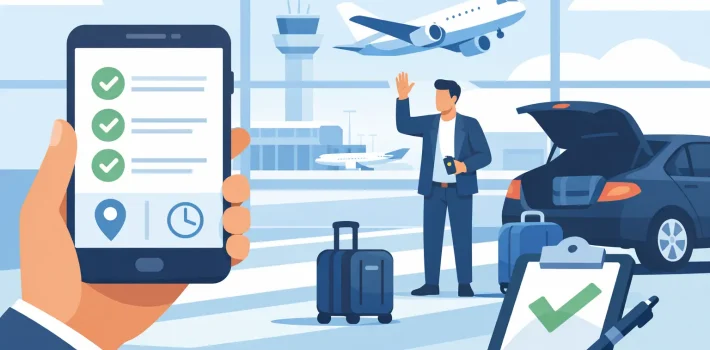
Meeting someone at the terminal sounds simple until the flight lands early, the phone battery dies, or nobody is quite sure which pickup point to use. A solid airport pickup checklist helps you avoid those last-minute problems and keeps the journey home as straightforward as it should be.
For families, business travelers, and anyone collecting a guest, the difference usually comes down to preparation. Airport pickups involve moving parts – flight times, baggage delays, traffic, parking rules, and clear communication. If even one detail is missed, the whole handover can become slow and frustrating.
Why an airport pickup checklist matters
Airport journeys are time-sensitive in a way that many local trips are not. When you are collecting someone from an airport, you are working around airline schedules, terminal procedures, road congestion, and restricted stopping areas. That means guesswork is rarely your friend.
A proper airport pickup checklist is not about overplanning. It is about making sure the basics are covered before the passenger arrives. That includes confirming the terminal, checking live flight updates, agreeing on a meeting point, and making sure the right vehicle is booked for the number of passengers and bags.
This becomes even more important when the arriving passenger is elderly, traveling with children, carrying a lot of luggage, or visiting the UK for the first time. In those cases, reliability and clarity matter more than speed alone.
The details to confirm before the day of travel
The first thing to check is the flight information. You need the airline, flight number, arrival date, and expected landing time. Relying only on a rough estimate such as “arriving around 6 pm” is where many pickup issues begin. Flight numbers allow real-time tracking and help you respond if the aircraft is delayed or arrives ahead of schedule.
Next, confirm the airport and terminal. This sounds obvious, but major London airports can have multiple terminals with different pickup arrangements, and passengers do sometimes assume that any driver can simply wait outside the doors. In reality, most airports have designated pickup zones, short-stay parking, or meet-and-greet procedures that need to be followed.
You should also confirm who is traveling and what they are bringing. One passenger with a cabin case needs a very different vehicle from a family of five with strollers and large suitcases. If the traveler uses a wheelchair or needs extra boarding and exiting support, that should be arranged in advance rather than dealt with at the curb.
Finally, agree on the contact method. A working mobile number for both the passenger and the person arranging the pickup is essential. If the traveler is flying in from abroad, check whether they will have roaming access, airport Wi-Fi, or another way to receive messages on arrival.
Your airport pickup checklist for the day
On the day itself, timing and communication matter most. Check the live flight status before leaving. The scheduled arrival time is useful, but live updates are more useful. An aircraft can land late, but it can also land early and still take time to disembark, pass border control, and collect baggage.
Leave enough margin for traffic. Airport runs are not just about mileage. Roadworks, peak travel times, motorway congestion, and airport access routes can all affect arrival. If the pickup is important, such as collecting a business guest or a family member after a long-haul journey, cutting the timing too fine is a risk not worth taking.
Before setting off, make sure these essentials are covered:
- Flight number and live arrival status
- Correct airport and terminal
- Passenger mobile number
- Agreed pickup or meeting point
- Vehicle size suitable for passengers and luggage
- Payment and booking confirmation if using a private hire service
- Extra requirements such as child seats or wheelchair access
That list is short, but it covers the details most likely to cause delays.
Picking the right meeting point
The best meeting point depends on the airport, the passenger, and the type of service being used. Some travelers prefer a pickup zone outside the terminal because they want to get moving quickly. Others are better served by a designated indoor meeting point, especially if they are unfamiliar with the airport or arriving after a tiring international flight.
There is a trade-off here. Kerbside pickup can be faster, but only if the passenger is ready to walk straight out and the airport permits short waiting times. Meet-and-greet style collection can be more convenient for the passenger, but it may involve parking charges and a little more coordination.
For children, older passengers, and first-time visitors, clarity is usually more valuable than speed. It is better to say “wait by the Costa inside Terminal 3 arrivals” than to send a vague message saying “I am outside.” Specific instructions save time.
What passengers should do after landing
The smoothest airport pickups happen when the arriving passenger knows the plan. Ask them to switch their phone on as soon as possible after landing and send a quick message once they have cleared immigration or collected their bags. That update matters more than the landing time itself, because baggage reclaim and border queues can vary widely.
If they have checked luggage, remind them not to rush to the pickup point before they are actually ready. Many missed collections happen because one person is circling outside while the other is still waiting at the carousel.
If the traveler is unfamiliar with the airport, keep your instructions simple. One clear message with the terminal, pickup point, and vehicle details is better than several half-explanations sent across different apps.
When booking a private hire service
If you are using a private hire company rather than collecting the passenger yourself, your checklist should also include the booking details. Confirm the booking time, pickup procedure, vehicle type, and whether flight monitoring is included. A reliable airport transfer service should be able to adjust for delays when given the correct flight information.
This is also where practical details matter. If the journey includes several passengers, extra luggage, golf clubs, folding wheelchairs, or child seats, mention that when booking. A standard saloon may be fine for some journeys, but not for every airport collection.
For business travel, presentation and punctuality carry extra weight. If you are arranging transport for a client, colleague, or senior visitor, you want a service that is clear, licensed, and prepared for schedule changes. For family travel, reassurance often matters more – especially if the passenger is arriving late at night or traveling alone.
In Watford and the surrounding area, many passengers want exactly that balance: straightforward booking, dependable arrival times, and a vehicle that matches the trip. That is why local airport transfer services such as 247 Cars Watford focus on practical details rather than vague promises.
Common mistakes that cause airport pickup problems
The biggest mistake is not checking the terminal. The second is leaving communication too loose. Telling someone “call me when you land” is not enough if they do not have signal, if immigration takes an hour, or if you are already waiting in the wrong place.
Another common issue is underestimating luggage. People often think in terms of passenger numbers and forget that airport trips are really about passengers plus baggage. Four adults with four large cases may need more space than expected.
The final mistake is assuming all airports operate the same way. They do not. Pickup fees, waiting rules, access roads, and meeting points differ, and those differences affect timing. A little checking beforehand usually prevents a lot of stress later.
A checklist that works for return journeys too
A good airport pickup checklist is just as useful for return travel when you are arranging transport to bring someone home. In many cases, the return leg is when passengers are most tired, especially after long-haul flights, delays, or overnight travel. That is when a clear plan matters most.
If you are booking for somebody else, send them all key details before they fly, not after they land. That means the driver details if available, the meeting point, what to do in case of delay, and who to contact if plans change. Passengers feel more confident when they know exactly what happens next.
Airport collections rarely go wrong because of one major problem. More often, they go wrong because of several small ones – unclear timing, poor communication, or the wrong vehicle. Get those details right, and the journey home starts calmly, which is exactly what most travelers want after a flight.
How to Choose the Best Taxi Service: What to Look For?
Need a ride across town but don’t feel like wrestling with traffic? Taxis are a lifesaver, but with so many companies out there, how do you pick the perfect one? How do you ensure you’re picking a reliable service that will get you to your destination safely and on time? Don’t worry, this guide will turn you into a taxi-hailing pro in no time, helping you navigate the options and select the perfect ride for your needs. Read More


